When I was in grad school, we had several literacy-based speech therapy classes and clients with language learning disorders. Dr. Jan Norris was one of my professors, and a lot of her work has consisted of extensive research in communicative reading strategies. Dr. Norris is the creator of phonics faces, visual grammar, spuzzles, and storyboards. You can check out more of her creations at this website.

All that to say, I’ve never not done literacy-based speech therapy. It was ingrained into me from the get-go, and I’ve developed an unhealthy obsession with picture books ever since. 😉
A couple definitions:
Communicative Reading Strategies– A holistic intervention consisting of various strategies to facilitate higher level language use in children with oral and written language difficulties. In other words, they use prompts, cues, and dialogue to support children in understanding the meaning of print.
Literacy-based therapy– The overall term for using books or other literature in your speech therapy sessions.

Let’s dig a little bit deeper into communicative reading and what it entails.
1. Interactive reading
- Choose specific books and objectives to target.
- Take your time reading through the book.
- Teach the language and content while you read.
- Continually monitor student comprehension.
- Scaffold and breakdown the text as needed.
2. Dialogic reading
This just refers to carefully planned readings that are interactive and student-centered. It involves a lot of conversations and discussions throughout the reading. When questioning during readings, you can usually think of the word CROWD, which represents the following:
- C- Cloze: Leaving blanks for the student to complete in your sentence (i.e. The girl saw a _____.)
- R- Recall: Straightforward, right there recall questions (i.e. What did the boy climb?)
- O- Open-ended: Discussion questions that can have a variety of answers (i.e. Why do you think the boy did that?)
- W- WH questions: Who/what/when/where/why (i.e. Where did the girl go after she ran away?)
- D- Distancing: Questions that make a connection to the student’s opinions or experiences (i.e. How would you feel if you were in that situation?)
3. Prep sets
- Provide students with background knowledge prior to reading the text.
- Picture walk through the book.
- Make predictions of what might happen before each page.
- Prepare the student for understanding the content.
4. Tackle the text
- Break down complex sentence structures, like clauses and phrases.
- Explain difficult vocabulary in kid-friendly terms.
- Read the text in chunks and check for understanding.
- Re-read portions of the text if needed.
- Summarize the reading at the end.
- Use graphic organizers, storyboards, and other aids to help with comprehension.

Here are a few of my favorite TIPS for incorporating these strategies into your speech sessions:
1. Choose the right book
Not just any book will do. You’ve got to choose a book that will lend itself to your students’ developmental age, specific goals and objectives, and one that you can actually read in one session (or easily chunk into multiple sessions).
2. Plan

No matter how much of a pro you think you might be, a session will always go better if it’s well planned. I know time for planning is not usually on our side, but if you can make time for it, you’ll thank yourself later.
A few planning tips:
- Read through the book beforehand
- Note vocabulary, categories, concepts, difficult ideas, complex sentences, background knowledge they may need
- Jot down questions you can ask – think CROWD
- Think about your students’ goals and what you want to target with that book
3. Use visuals
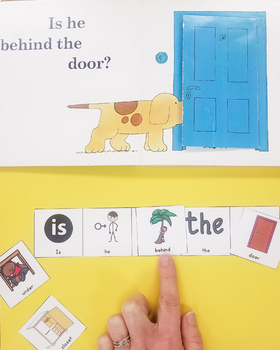
Pull out all the stops, y’all. Visuals are key. They are a game changer for engagement as well as comprehension. Plus, it lets you work on several different skills at once. Here are the visuals I like to use:
- Story props- objects, puppets, pictures (anything to represent the characters)
- Visual sentence strips – These are really great if a book has a lot of repetition in it. For example, take a look at how these sentence strips pair so well with Jump Frog Jump!
4. Pick one goal at a time
Level your interactive reading according to student need. You can read the same book with multiple students for a variety of purposes. Choose one goal and focus on that goal while you read the book. Then read it again with another goal in mind. Here are some examples:
- Labeling: Talk about what the objects in the pictures are. Do a lot of cloze questions. Have student “touch the ___.” Focus on the vocabulary.
- WH questions: Ask different types of questions (CROWD). Use scaffolds and point prompts as needed. Provide visual sentence strips with responses.
- Following directions: Have students point to pictures in different orders. Give them directions on what you would like them to read or do with the book or props.
- Straight comprehension: Pull out all of those reading strategies, prep sets, and questioning. Read interactively and break down that text with the student.
Keeping one focus makes it easier for you to take data and lets the student know what to expect as well.
5. Reinforce the skill

A good book companion just makes life easier. I try to reinforce the skills we worked on in the book with cards, a worksheet, or activity that goes along with the book. It helps with carryover and it lets you see where they might be breaking down. Plus, companion pages many times provide visuals and scaffolds that my students might need.
If you need some book companions, I do have several in my TPT store!
You can also grab these free planning pages from my resource library when you join the BBS community!


Such a thoughtful and helpful breakdown! Thanks, Lauren!
So glad it’s helpful!