My student stared at me across the kidney table with big brown eyes. I recognized the blank look. We had read a passage together, and now I was asking him questions about what we read.
We needed to back it on up a step. I took out a shorter passage that included a visual picture. We read it and referenced the pictures, and he was able to achieve more success with the task.
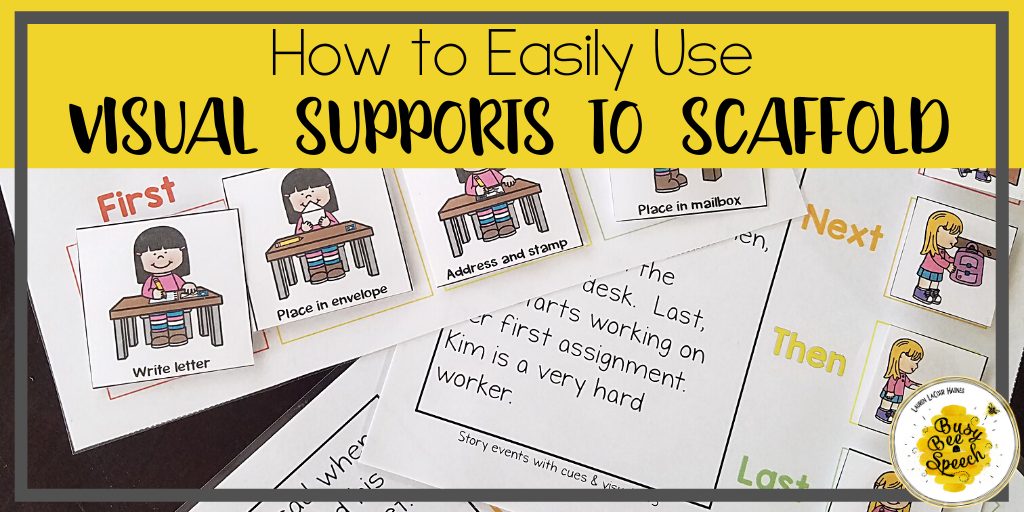
As SLPs or special educators, we know about the importance of knowing how to use visual supports with our students. We might also know that there are many different ways that visual supports can benefit our students.
Visuals aren’t only for AAC devices and self-contained classrooms. We can use them with our students who have learning disabilities or language disorders as well. If you work in the schools, you never know who will walk through your door next or what they’ll need.
In case you are a little fuzzy on the term, visuals are a type of picture prompt that gives the student extra support in learning and mastering a new skill. It can provide information about the correct answer, aid in organizing thoughts or help to explain how to do something.
Today, I’m going to tell you a few different types of visual supports that you can use as an easy prompt as well as how to use visual supports to level your therapy goals! Don’t worry, I’ll include a few visuals to help you. 😉
COMMON TYPES OF VISUAL SUPPORTS
1. Graphic Organizers
There are tons of different graphic organizers out there. These are tools that help organize ideas and information in a visual way that is easier to understand.

We can use these for lots of goals: bubble maps for articulation words, Venn diagrams for compare/contrast, flow maps for sequencing, etc.
2. Color-Coding

I like to use color-coding when I want to separate items into groups. Whether it’s categories, sound position in words, or first/next/last, color coding is a great visual. It helps students to follow directions more easily and retain information.
3. Highlighting

When text is involved, I always pull out the highlighter. We can use it to place pauses for a fluency strategy, find our /r/ words, or highlight the context clues for our vocabulary words. In the picture above, we highlighted the evidence in the text that supported our inferencing questions.
4. Drawings
For my older students, I never like to push into a classroom without bringing my mini whiteboard and dry erase marker. It was an easy place for me to draw pictures out of sight words, draw a visual representation of the math word problem, or draw pictures of fluency strategy reminders. Sticky notes are great for this too!
5. Pictures
A picture is worth a thousand words, right? That’s because they’re powerful. Having picture supports of a story can significantly improve comprehension, help to make inferences, and aid in recall.

We all like it when directions that we are using have visuals that go along with them. Think of how much more they might benefit a student with a language disorder.
There are several more types of visuals like charts, graphs, videos, and signs. I just wanted to cover the main ones that I typically use in my therapy sessions.
HOW TO USE VISUALS TO LEVEL YOUR THERAPY GOALS
Now, let’s switch gears a second and talk about specific ways that you can use these visuals as a prompt or scaffold to level your goals.
Step 1: Choose a goal or skill
Choose a child’s goal or target skill that would allow for visual supports. Here are a few that have worked really well with a visual scaffold:
- Comprehension
- Making inferences
- Sequencing
- WH questions
- Predicting
- Context clues
- Following directions
Step 2: Deconstruct the goal
Think about how you could address the skill as independently as possible and as scaffolded as possible. Ask yourself:
- What would zero visual supports look like with this goal?
- Could I take out all the language and JUST use a visual to address the goal?
- Then, break the skill down into levels. What are the smaller parts of the skill that the student may need to address?
Example: Sequencing 4 events in a story
- 2 steps familiar activity with visuals, 2 steps without visuals
- 3 steps familiar activity with visuals, 3 steps without visuals
- 4 steps familiar activity with visuals, 4 steps without visuals
- Story sequence 4 events with visuals
- Story sequence 4 events without visuals
Step 3: Decide on the type of visual the student needs
Where does the student’s ability fall in the breakdown of the goal? What kind of visual would best fit the goal AND the needs of the student?
Maybe they just need a graphic organizer and they’re good to go. Maybe the student needs picture supports to be able to comprehend the text. Probe by giving your students different tasks and supports to find out where they fall.
PUTTING IT INTO PRACTICE
Visuals are a great prompt to implement because they are the easiest to fade. Put together a kit of graphic organizers, highlighters, and whiteboards to quickly add visual support. Start collecting materials that include visuals or can easily have them added.

I have a section in my TPT store called “Scaffolded Products” if you need somewhere to start. These Inferences and Text Evidence resources have 3 levels: 1. Picture only 2. Pictures + Text 3. Text only
My sequencing resource includes 5 levels. I’m adding new scaffolded materials all the time. Let me know what leveled resource you’d like to see next!

[…] prompts and scaffolds. We’ve spent time talking about the importance of verbal prompts and visual prompts in the […]